Continuous improvement work tends to fail in one of two ways: a great root-cause analysis that never ships, or fast delivery that solves the wrong problem. The framework I use links the two. DMAIC decides what to fix. Agile decides how to deliver it.
👉 Explore the interactive framework 👉 Get the templates on GitHub
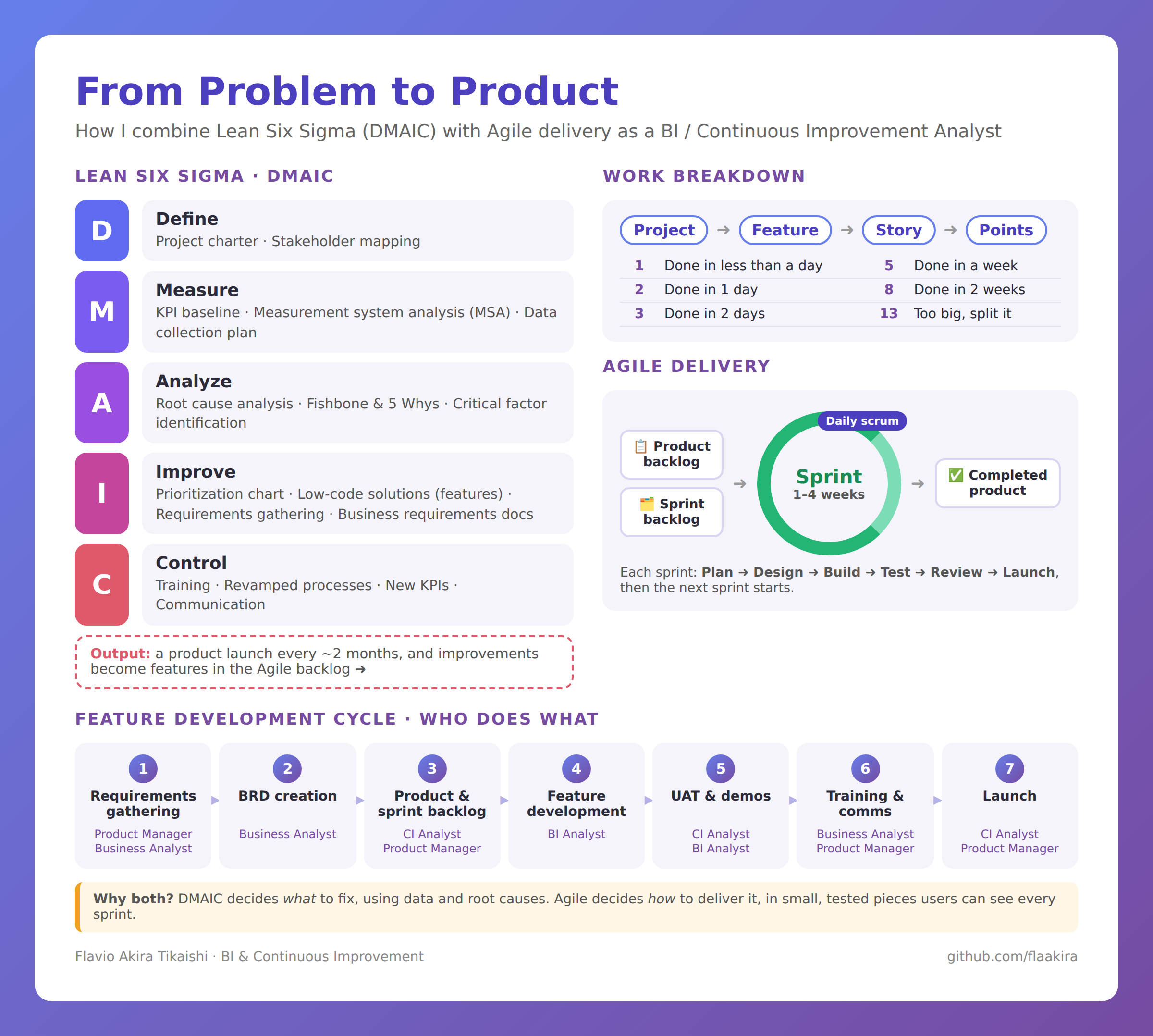
1. DMAIC finds the right problem
- Define: project charter and stakeholder mapping. What are we solving, for whom, and what does success look like?
- Measure: KPI baseline, measurement system analysis (MSA) and a data collection plan. Before trusting a number, check that it measures what you think it does.
- Analyze: root cause analysis, fishbone and 5 Whys, and critical factor identification.
- Improve: a prioritization chart (impact vs. effort), low-code solutions, requirements gathering and business requirements documents.
- Control: training, revamped processes, new KPIs and communication.
2. The bridge: solutions become features
In Improve, every prioritized solution becomes a feature in the Agile product backlog. Work is broken down as Project → Feature → Story → Story points:
| Points | Meaning |
|---|---|
| 1 | Done in less than a day |
| 2 | Done in 1 day |
| 3 | Done in 2 days |
| 5 | Done in a week |
| 8 | Done in 2 weeks |
| 13 | Too big: split it |
3. Agile delivers it in small pieces
Product backlog → sprint backlog → sprints of 1–4 weeks with a daily scrum → completed product. Each feature follows seven steps, each with clear owners:
- Requirements gathering: Product Manager, Business Analyst
- BRD creation: Business Analyst
- Product & sprint backlog: CI Analyst, Product Manager
- Feature development: BI Analyst
- UAT & demos: CI Analyst, BI Analyst
- Training & comms: Business Analyst, Product Manager
- Launch: CI Analyst, Product Manager
Control closes the loop, and a new product launch ships about every 2 months.
Free templates
The GitHub repo has 15 Markdown templates you can copy, one for every step of the framework:
| Phase / step | Templates |
|---|---|
| Define | Project charter · Stakeholder map |
| Measure | Data collection plan & KPI card · Measurement system analysis (MSA) |
| Analyze | Root cause analysis (fishbone + 5 Whys + Pareto) |
| Improve | Prioritization chart · Requirements gathering guide · BRD · Low-code solution design |
| Agile delivery | User story & story points · Sprint planning, daily scrum, review & retro · UAT checklist |
| Control & launch | Control plan · Training & communication plan · Release & launch notes |
Tools & skills: Lean Six Sigma (Green Belt) · Agile/Scrum · requirements gathering · BRDs · KPI design · UAT · change management